Peer-reviewed academic journal articles
- Michel Pohl, Mitsuru Uesaka, Hiroyuki Takahashi, Kazuyuki Demachi, and Ritu Bhusal Chhatkuli, "Frame forecasting in cine MRI using the PCA respiratory motion model: comparing recurrent neural networks trained online and transformers", Computerized Medical Imaging and Graphics (2026).
[arXiv preprint]
[Published version]
[Code on GitHub]
This study applies RNN online learning algorithms for the first time to frame forecasting in chest and liver cine MRI and compares them with transformers. These algorithms are integrated within a modular, interpretable, and data-efficient pipeline combining deformable image registration, PCA-based respiratory motion modeling, and temporal breathing-dynamics prediction. Performance was broadly in line with prior literature on respiratory MRI forecasting, including works exploring end-to-end generative architectures. Online-trained RNNs outperformed other methods at medium-to-long horizons (the time interval in the future for which the prediction is made), while sequence-specific transformers were competitive at low-to-medium horizons.
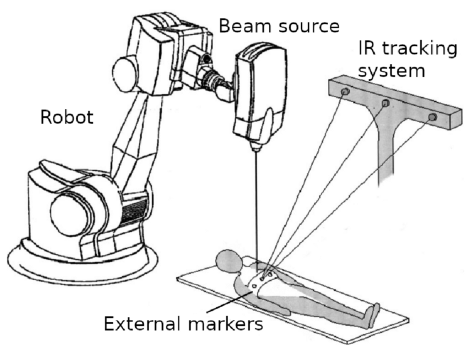
- Michel Pohl, Mitsuru Uesaka, Hiroyuki Takahashi, Kazuyuki Demachi, and Ritu Bhusal Chhatkuli, "Real-time respiratory motion forecasting with online learning of recurrent neural networks for accurate targeting in externally guided radiotherapy", Computer Methods and Programs in Biomedicine (2025).
[arXiv preprint]
[Published version]
[Code on GitHub]
This study investigates RNN online learning algorithms, including Decoupled Neural Interfaces (DNI) and Sparse One-Step Approximation (SnAp-1), for respiratory motion forecasting from external chest and abdomen markers, examining the combined effect of sampling rate and horizon on their performance. I exploited sparsity in the influence and immediate Jacobian matrices to derive a compressed formulation of SnAp-1 with lower memory and computational complexity. For DNI, I derived improved coefficient-update equations for credit-assignment estimation, yielding more accurate forecasts. Despite sequence-wise training and testing on a small dataset with irregular breathing records, online-trained RNNs achieved accuracy comparable to prior deep learning approaches trained on substantially larger datasets.
- Michel Pohl, Mitsuru Uesaka, Hiroyuki Takahashi, Kazuyuki Demachi, and Ritu Bhusal Chhatkuli, "Prediction of the position of external markers using a recurrent neural network trained with unbiased online recurrent optimization for safe lung cancer radiotherapy", Computer Methods and Programs in Biomedicine (2022).
[arXiv preprint]
[Published version]
[Code on GitHub]
[Blog article, Towards Data Science Editors' Pick]
This study is the first to apply Unbiased Online Recurrent Optimization (UORO), a computationally efficient online learning algorithm for RNNs that approximates Real-Time Recurrent Learning (RTRL), to respiratory motion forecasting through prediction of external thoracic and abdominal marker positions. I proposed an efficient implementation of UORO for vanilla RNNs by deriving closed-form expressions governing the recursive update of rank-one stochastic estimates of the influence matrix (i.e., the state–parameter Jacobian), from which unbiased online loss-gradient estimates are obtained. UORO yielded the lowest RMSE among the algorithms compared (1.3 mm across horizons below 2.0 s) while remaining robust to irregular breathing patterns. It also maintained prediction times below 2.8 ms per time step, compared with over 55 ms for RTRL (Dell Intel Core i9-9900K 3.60 GHz).
- Michel Pohl, Mitsuru Uesaka, Kazuyuki Demachi, and Ritu Bhusal Chhatkuli, "Prediction of the motion of chest internal points using a recurrent neural network trained with real-time recurrent learning for latency compensation in lung cancer radiotherapy", Computerized Medical Imaging and Graphics (2021).
[arXiv preprint]
[Published version]
[Code: Lucas–Kanade 3D optical flow]
[Code: RTRL]
[Code: Nadaraya–Watson 3D image warping]
I developed a method to reconstruct and forecast 3D lung tumor ROIs in time-resolved CT acquisitions from an initial frame and the trajectories of internal points tracked with the Lucas–Kanade optical-flow algorithm. This approach combines a linear correspondence model relating the motion of these points to tissue motion with RNNs trained using RTRL, a classical online learning algorithm for RNNs based on exact recursive computation of the influence matrix. RTRL yielded a maximum prediction error of 1.5 mm for the tracked points, below the 2 mm clinical guideline threshold, and a Pearson correlation coefficient of 0.95 between predicted and ground-truth images. Tumor positions in the predicted frames remained qualitatively consistent with the ground truth.
Selected technical blog articles and project reports
- Michel Pohl, "Graph-structured data classification based on spectral methods and the generalized likelihood ratio test", blog article, 2026. Based on work conducted in 2016 at Centrale Méditerranée/Fresnel Institute under the supervision of Mouloud Adel.
[Blog article]
[Code on GitHub]
I implemented a binary classifier for graph-structured data, combining generalized likelihood ratio testing and graph Fourier transforms. I applied this method to Alzheimer's disease detection by modeling brain regions in PET images as nodes in a graph whose edge weights encode similarity between regional imaging feature values. This approach yielded a leave-one-out test F1 score of 0.85 on 142 brain scans.
- Michel Pohl, "Modélisation biomécanique d'une structure fibrée périodique" [Biomechanical modeling of a periodic fiber-bundle structure], technical report, Centrale Lille, 2015. Supervision: Stefano Giordano, Fabio Manca (IEMN).
[Code, report, and selected results on GitHub]
I studied a mechanical model of an inhomogeneous periodic structure composed of two elastically coupled fibres subject to an axial load. Specifically, I formulated a system of coupled ordinary differential equations and used it to study its effective stiffness under varying length, coupling strength, and boundary conditions. I numerically estimated the effective Young's modulus and derived closed-form expressions in simplified configurations, characterized asymptotic regimes (including weak/strong coupling and long chain behavior), and analyzed its sensitivity to structural parameters.
Selected presentations and science communication
Show earlier presentations and public outreach
Conferences in Japan
- Michel Pohl, Mitsuru Uesaka, Kazuyuki Demachi, and Ritu Bhusal Chhatkuli,
"Prediction of the position of external markers on the chest and abdomen for latency compensation in radiotherapy", 121st Scientific Meeting of the Japan Society of Medical Physics, Yokohama, April 2021.
[One-page proceedings abstract, self-hosted PDF]
[Slides, self-hosted PDF]
- Michel Pohl, Mitsuru Uesaka, Kazuyuki Demachi, and Ritu Bhusal Chhatkuli,
"Prediction of the position of external markers on the chest and abdomen using a recurrent neural network trained with real-time recurrent learning for accurate and safe lung cancer radiotherapy", 2021 Spring Meeting of the Atomic Energy Society of Japan, online, March 2021.
[Presentation information]
[One-page proceedings abstract]
- Michel Pohl, Mitsuru Uesaka, Kazuyuki Demachi, and Ritu Bhusal Chhatkuli,
"Prediction of the position of internal points using a recurrent neural network trained with real-time recurrent learning for latency compensation in lung cancer radiotherapy", Student poster session of the 2020 Fall Meeting of the Atomic Energy Society of Japan, online, September 2020.
[One-page abstract, self-hosted PDF]
International workshops
- Michel Pohl, Mitsuru Uesaka, Kazuyuki Demachi, Ritu Bhusal Chhatkuli, and Akihiro Haga, "Optical flow for the calculation of lung motion during X-ray radiotherapy", SNU & Utokyo Joint Workshop, Seoul, July 2017.
Science communication
- Michel Pohl, short introduction to tumor tracking with the Lucas–Kanade optical-flow algorithm for lung radiotherapy, featured in Dr Nozman's YouTube video "La meilleure école japonaise!" (April 2017). Subtitles available in English.
Scholarships, grants, and awards
- Sept. 2018–Sept. 2021: SEUT-RA (The University of Tokyo Doctoral Student Special Incentives Program).
Competitive doctoral research grant; received support throughout 2018–2021, including SEUT-RA Type A in 2019–2020, awarded to the top 20 second-year Ph.D. applicants at the Graduate School of Engineering.
- Apr. 2019–Apr. 2021: Scholarship from the Epson International Scholarship Foundation.
Two-year scholarship awarded following a competitive selection process, including interviews in Japanese at Epson on research activities and future plans.
- March 2018 and March 2019: Idea Prize and Encouragement Prize, Atomic Energy Society of Japan.
Awarded for my poster at the AESJ Spring Annual Meeting (2018) and my presentation at the AESJ Student Meeting (2019).
-
2016: Valedictorian, M.Sc. in Signal and Image Processing, Centrale Méditerranée [Award ceremony video].
-
Sept. 2016–March 2017 and Sept. 2017–March 2018: MEXT/JASSO Honors Scholarship for Privately-Financed International Students.
Service
- 2023: reviewer for IEEE Access.